
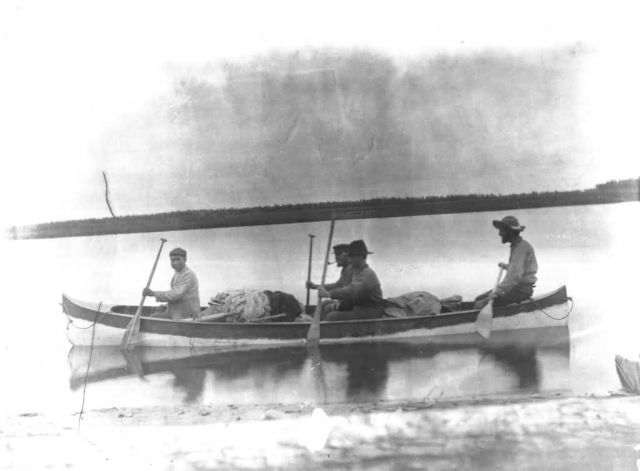
Eskimo kayak and boy at Bethel, Kuskokwim River. The Hinckley party starting from Bethel for the Yukon. In 1898, the USGS sponsored a geologic and topographic reconnaissance of southwestern Alaska. Josiah Edward Spurr led a three canoe expedition that departed Tyonek (Cook Inlet) in early May. The party ascended the Susitna, Yentna, and Skwentna rivers and portaged into the main stem river and continued downstream to Memtrelegamut (Bethel Mission), arriving there on August 10. They remained there for a week before the expendition continued on after splitting into two parties. One party, pictured in the canoe, consisted of F.C. Hinckley (camphand/naturalist), A.E. Harrell (camphand), John Madison (camphand), and an unidentified Native [Alaskan] man. Departing Bethel mid-August, they retraced their route upstream to the Yukon River portage, followed that waterway to the Yukon, descended the Yukon River, and eventually arrived in St. Michael. Spurr and the three other members of the expedition (W.S. Post, Oscar Rohn, and George Hartman) followed lengthy coastal and inland route to the east, arriving in the village of Katmai on Shelikof Strait on October 17. The Native [Alaskan] boy pictured in the single-hatch kayak is unidentified. One distinguishing feature of this kayak is the circular opening at the bow, representative of single-hatch kayaks of the Kuskokwim Bay and Nunivak Island areaas in the 18th and 9th centuries.
Hide.


